People are typically polite. They won’t tell you your website feels a little off, outdated, or out of step with your business. They won’t email you to let you know the photos look old, the messaging feels generic, or the contact form made them hesitate. They’ll just quietly form an opinion and move on.
That is the frustrating thing about an outdated website. It usually does not fail loudly. It does not throw up a giant red flag that says, “Hey, you just lost a lead.” Instead, it creates small moments of doubt.
A visitor lands on your site. Something feels a little off. The design feels behind. The content does not quite match what they expected. The site loads slowly. The photos look like they were taken three office renovations ago. The services are technically there, but nothing feels current or clear.
So they leave. No angry phone call. No dramatic complaint. No helpful explanation. Just another potential customer who almost called.
Your Website Is a First Impression Running Unsupervised
Your website is often the first place someone goes after hearing your name.
They may have been referred by a friend. They may have seen your truck, sign, social post, ad, or business card. They may already have a little interest. They may even be close to making a decision.
Then they visit your website to confirm the feeling. That is the keyword: confirm.
Most people are not visiting your site just to gather basic information. They are checking to see if you feel legitimate. They are looking for signals. Do you look professional? Do you seem active? Do you understand what they need? Does your business feel like it is still moving forward?
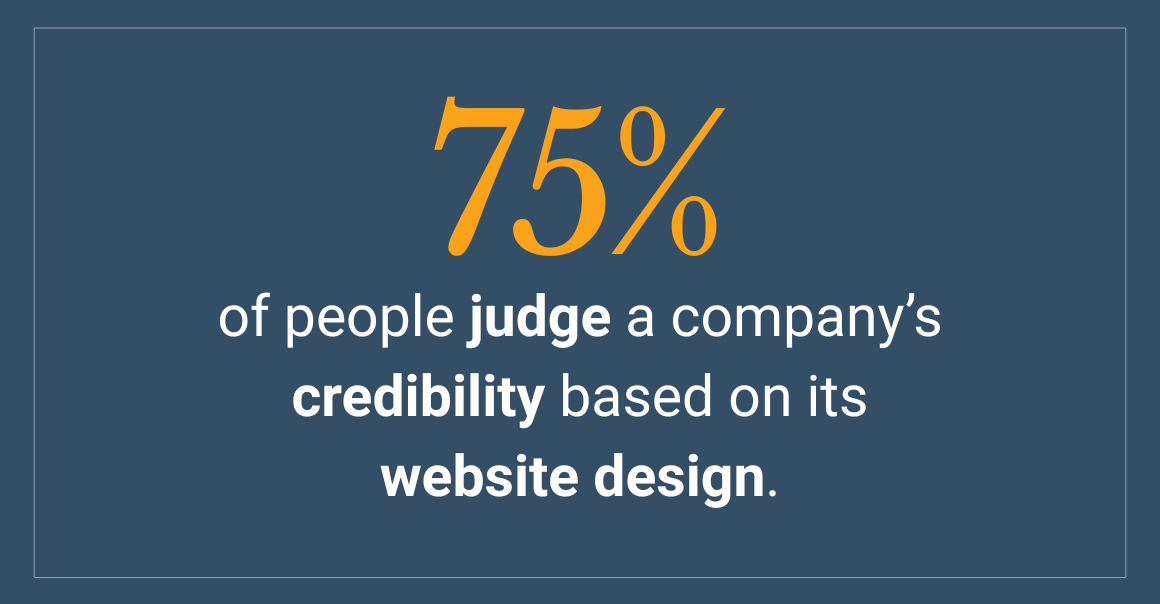
A frequently cited Stanford-related statistic says that 75% of people judge a company’s credibility based on its website design. Stanford’s own credibility guidelines also point to professional site design as a major trust factor, based on years of research with thousands of participants.
That matters because people make decisions before they ever contact you. Before they read every word. Before they compare every service. Before they meet your team. Before they give you a chance to explain. Your website is already speaking for your business. The question is whether it is telling the right story.
Outdated Does Not Always Mean Broken
A website does not have to be completely unusable to be hurting your business.
Sometimes it works “fine.” The pages load. The phone number is there. The form technically submits. The logo is still recognizable. Nothing is on fire. But “fine” is not always enough.
Outdated can look like:
- A homepage that no longer reflects your best services.
- A brand message that sounds like the company you were five years ago.
- A mobile experience that feels cramped or clunky.
- Old team photos, old project photos, or old service descriptions.
- Navigation that makes sense internally, but not to a new visitor.
- A design that feels small compared to the level of work you now provide.
- A site that does not clearly guide people toward calling, filling out a form, or taking the next step.
None of those things may feel like a crisis on their own. But together, they create friction. And friction is expensive.
Every touchpoint that does not reflect where your business is today creates a small, silent leak of credibility. Not a crisis, but it compounds. And the longer it runs, the more it can cost you in the clients who almost reached out.
Your Business Has Probably Evolved
This is where many successful businesses get stuck. You built a website when you needed one. At the time, it made sense. It helped explain who you were, what you offered, and how people could reach you.
But then your business grew. You sharpened your services. You improved your process. You hired better people. You invested in equipment, training, operations, systems, branding, and customer experience. You learned what type of clients are the best fit. You became more specific and more confident in what you do.
That is the work. But if your website, positioning, and identity still say who you were two years ago, that is who people think they are calling. This is especially important for service-based businesses. Your website is not just a place to list what you do. It is where people decide whether you feel like the right fit. And when your business has grown but your website has not, there is a disconnect.
You may be offering a better experience than your competitors, but your site may not make it obvious. You may have more experience, better systems, better service, or a stronger team, but if that story is buried or outdated, people may never get far enough to find out.
Design Is Part of Trust
Some business owners hear “website design” and think it only means colors, fonts, and pretty pictures. But design is much bigger than that. Good design helps people understand where they are, what you do, why it matters, and what they should do next. It creates order. It reduces confusion. It makes the business feel active and trustworthy.
Bad or outdated design does the opposite. It makes people work harder. It creates uncertainty. It can make a strong company feel smaller, less experienced, or less organized than it really is. And yes, that judgment may be unfair. A business can be great at what it does and still have a dated website. But potential customers do not know that. They only know what they see. The website becomes the evidence.
That is why an outdated site can be so costly. It may not reflect the real quality of your work. It may not reflect your team, your process, your reputation, or your results. It may simply reflect a version of your business that no longer exists.
Messaging Matters Just as Much as Visuals
A website can look modern and still miss the mark. If the copy is vague, generic, or overly focused on the company rather than the customer, people may still leave confused.
A strong website should answer the questions your visitors are already asking:
- Do you understand what I need?
- Have you helped people like me before?
- What makes you different?
- Can I trust you?
- What happens if I reach out?
- Why should I choose you over the other company I am considering?
We talk a lot about the purpose behind marketing. A good website should not just exist because every business needs one. It should have a job. It should support your sales process, explain your value, and help people feel confident taking the next step.
That starts with clear messaging. Your website should sound like your business on its best day. Not stiff. Not generic. Not overloaded with industry language. Just clear, helpful, and aligned with the way you actually talk to customers.
When the visuals and message work together, your site becomes much more than a digital brochure. It becomes a practical sales tool.
Your Website Should Make Life Easier for Your Sales Team
A strong website does not replace conversations. It makes them better. When your site clearly explains your services, process, pricing expectations, project types, FAQs, and next steps, potential customers show up more informed. They understand what you offer. They have a better sense of fit. They are more prepared for a productive conversation. That helps your team spend less time explaining the basics and more time helping qualified prospects move forward.
An outdated website often does the opposite. It creates confusion before the first call. People ask questions your website should have already answered. They misunderstand what you do. They inquire about services you no longer prioritize. They compare you to lower-quality providers because your site does not make your value clear. That is not just a website problem. That could also be a sales problem.
Performance and Security Matter Too
Outdated websites are not only a branding issue. They can also create technical problems. Older sites may load slowly, especially on mobile. They may rely on outdated plugins, unsupported themes, or bloated code. They may not meet current expectations for security, accessibility, search visibility, or conversion tracking.
And when the technical side of your website is ignored, it can affect more than the user experience. It can impact how well your site performs in search. It can make paid ads less effective. It can create issues with forms, tracking, analytics, backups, and updates. It can also make future improvements more difficult and more expensive.
This is one reason we believe websites should be built with long-term use in mind. A website should be easy to update, easy to manage, and flexible enough to grow with the business. Because your website is not finished the day it launches. That is just the day it starts working.
The Real Cost Is the Lead You Never Knew You Lost
The hardest part about measuring an outdated website is that you rarely see the full cost. You can see the leads that came in. You can see the phone calls, forms, and email inquiries. But you cannot always see the people who left because the site did not feel right. You cannot see the person who was referred to you, visited your site, and then chose someone else. You cannot see the visitor who liked your work but could not quickly find the information they needed. You cannot see the customer who assumed your business was smaller, slower, or less experienced because your website felt behind.
That is the silent part. An outdated website does not just cost you attention. It can cost you trust before you ever get a chance to earn it.
A Better Website Does Not Have to Mean Starting Over Completely
Sometimes a business needs a full redesign. Sometimes the brand, structure, content, and technology all need to be rebuilt from the ground up. But not always. In some cases, meaningful improvements can start with better messaging, stronger calls to action, updated photography, cleaner navigation, better service pages, improved mobile formatting, or clearer lead paths. The right move depends on where your site is now and where your business is trying to go.
That is why we always start by listening and asking questions. What are you trying to accomplish? What types of leads are most valuable? What is confusing customers now? What services or audiences matter most moving forward? What does your current website do well, and where is it holding you back?
A good website project should not be about chasing trends. It should be about building something that reflects your business clearly and supports real goals.
Your Website Should Match the Business You Are Today
If your company has grown, improved, repositioned, or become more focused, your website should show that. Not in a flashy way. Not in a “look how great we are” way. In a clear, confident, useful way.
Your website should help people understand what you do, why it matters, and why your business is the right choice. It should make the next step easy. It should support your reputation, not quietly work against it.
Because your business has probably evolved. You got sharper. More specific. Better at exactly what you do. Your website should not be the last place that still looks like the old version.
Is Your Website Telling the Right Story?
If your website feels dated, unclear, hard to update, or disconnected from where your business is today, it may be time to take a closer look.
We help businesses build websites that are practical, professional, and built around real business goals. We focus on clear messaging, smart design, strong functionality, and the kind of digital presence that helps people feel confident choosing you.
Because an outdated website is not just a design issue. It is a credibility issue. And credibility matters long before the phone rings.